15 questions
General knowledge
Pass mark 12 of 15 correct
12 must be right 3 you can miss
Sit the real 45-question format, get an honest verdict, and see the exact topics to fix — free, no signup.
100% free No account. No card. Nothing to install.
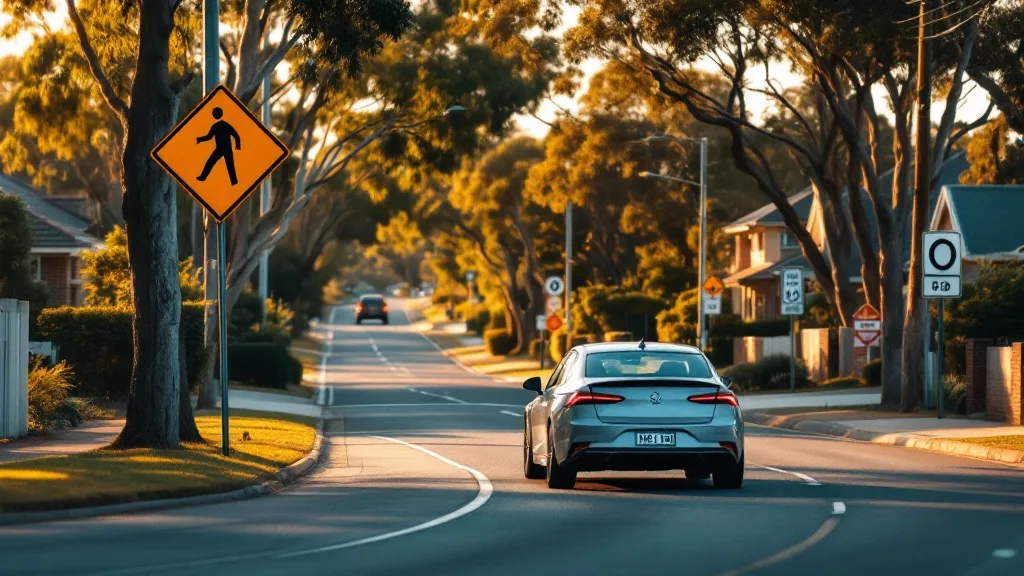
What would you do here? Every practice question drops you into a real NSW road situation — then explains the safe answer.
The Driver Knowledge Test is 45 multiple-choice questions, sat on a touchscreen at a Service NSW centre. It is marked in two halves, and each half has a pass mark of its own. Here is exactly what you are aiming at — and the way to get there.
15 questions
Pass mark 12 of 15 correct
12 must be right 3 you can miss
30 questions
Pass mark 29 of 30 correct
29 must be right 1 you can miss
The two marks are counted separately, so a strong total cannot rescue a weak half. 41 out of 45 can still be a fail: 15 out of 15 in general knowledge with 26 out of 30 in road safety comes to 41 correct — and four wrong in road safety, where the rule allows one.
Four steps. The first three are free on this site, as many times as you like.
Work through the road rules and the road signs in small sets. Every answer carries a short plain-English explanation, so you learn the rule behind it instead of memorising a letter.
Take a complete mock in the real shape — 15 general knowledge and 30 road safety. No account, no card, and no limit on how many times you take it.
Each section is marked against its own pass mark, so you find out which half would have failed you — then go back to the topics that cost you and take it again.
Book with Service NSW and take it on the touchscreen. The real test is untimed, so you can read every question at your own pace.
Free, no account and no card — and the test opens right here on this page.
Independent study aid — not affiliated with Transport for NSW or Service NSW.
Practise the exact topics the Driver Knowledge Test covers — the road rules and the signs, in plain language.
No timer, no pressure. Repeat any topic as many times as you like until it clicks.
Get it wrong and you'll see a short, friendly explanation — so you learn the rule, not just the right letter.
Press start and you will sit questions in the real NSW Driver Knowledge Test format: 45 multiple-choice questions, split into the two sections the actual test uses — 15 general knowledge questions and 30 road safety questions. Answer each one, see whether you got it right, and at the end you get a verdict that judges each section on its own rule, exactly the way a NSW test centre does. There is no clock, no account and no limit on how many times you can go again. Most people who pass first go do a handful of these until the verdict comes back green two or three times in a row.
The Driver Knowledge Test, or DKT, is the computer-based theory test you sit at a Service NSW centre to get your car learner licence. It checks one thing: do you know the NSW road rules well enough to start driving under supervision? You answer 45 multiple-choice questions on a touchscreen, one at a time, choosing from a short list of answers. Pass it and you are issued a learner (L) licence, which lets you drive a car with a fully licensed supervisor beside you and an L plate on the car. The DKT is not the driving test and it is not the hazard perception test — it comes first, before you ever sit behind the wheel for a licence. It is drawn from the NSW Road Users' Handbook, so everything you are asked has an answer written down in one official book. That is the good news: there is nothing secret on it, and nothing you cannot prepare for.
New South Wales does not hand anyone a full licence in one step. You move up through a graduated system, because the risk of a crash is highest in a driver's first months on the road. For a car the path runs Learner (L) → Provisional P1 (red P) → Provisional P2 (green P) → full licence. The DKT is the very first gate. You must be at least 16 to sit it. Once you pass and hold your Ls, you build up supervised driving hours in your logbook, then sit the Hazard Perception Test and the practical driving test on the way to your P1. So the DKT is the start of the whole journey — clearing it is what lets everything else begin. Knowing where it sits also tells you what to focus on now: the DKT is pure road-rules knowledge, not car control, so every mark on it is won by reading and practice, not by driving experience.
The 45 questions are not one flat pile. The NSW DKT is built in two separate sections, and they are marked separately. The first section is 15 general knowledge questions — the everyday mechanics of holding a licence and sharing the road: speed limits, road signs, giving way, parking, licence conditions and the rules that keep traffic moving. The second section is 30 road safety questions — the higher-stakes material about avoiding crashes and protecting people: safe following distances, fatigue and alcohol, school zones, pedestrians and cyclists, seatbelts and child restraints, and reacting to hazards. The split matters, and not just for interest: the road safety section is twice the size and is marked to a far stricter standard, which is the single thing most people get wrong about this test. We explain exactly how it is scored below, and our free practice mirrors both sections so nothing on the day is a surprise.
Here is the part almost every other practice site gets wrong. The DKT is not passed on a single score out of 45. Each section has its own pass mark, and you must clear both. You need at least 12 of the 15 general knowledge questions correct, and at least 29 of the 30 road safety questions correct. Miss the mark in either section and you fail the whole test, no matter how well you did in the other one. This is why the popular shorthand of "get 41 out of 45" is misleading. Imagine you scored a perfect 15 out of 15 on general knowledge but got 26 out of 30 on road safety. That is 41 correct overall — but it is a fail, because road safety needs 29 and you got 26. The road safety section allows you just one wrong answer. We state this rule because it is the rule applied at NSW test centres, checked by the people who run this site; note that the current nsw.gov.au page does not print the section minimums, so treat any site quoting a flat percentage with caution and always confirm the current rules when you book. Our verdict tool marks each section against its own rule, so the pass or fail it gives you is the real one — not a flattered average that would let you walk into the centre unready.
45 questions in one sitting — but the total is not the test
15 of 15 general knowledge and 26 of 30 road safety is 41 correct — and still a fail, because road safety fell one short of 29.
45 questions in one sitting — but the total is not the test
15 of 15 general knowledge and 26 of 30 road safety is 41 correct — and still a fail, because road safety fell one short of 29.
At the end we mark each section against the real NSW rule and tell you plainly: ready, or not yet — and exactly which topics to fix.
Learners who pass first time tend to do the same three things. First, they read the NSW Road Users' Handbook properly at least once, because every question is drawn from it and skimming it leaves gaps. Second, they practise until they are consistently comfortable, not until they scrape a single lucky pass — the pool is large and rotating, so understanding why a rule exists is what carries you through a question you have never seen before. Third, in the last day or two they revise only their weak topics, the ones the verdict keeps flagging, instead of re-reading everything. Do not try to memorise answers; the questions change and the option order moves. A sensible rhythm is a full mock every day or two, a short topic drill on your weakest area in between, and a final look at road signs, which trip up more people than any other single topic. Our study guide lays this out as a three-day and a seven-day plan, and our full mock test and road-signs practice are the two drills to lean on.
Every question is drawn from the NSW Road Users’ Handbook. Read it once, properly.
Not a lucky scrape — sit full mocks until the verdict comes back green two or three times.
In the last day or two, revise only what the verdict keeps flagging — road signs trip up the most people.
One thing that quietly calms a lot of nerves: the NSW DKT is untimed. There is no clock counting down while you answer, so you can read each question carefully and think it through. Some practice sites show a timer to feel like a real exam, but the real test does not have one — do not let a fake clock rush you into mistakes you would not otherwise make. You book the test through Service NSW and pay the test fee at booking. On the day, bring the identity documents Service NSW asks for when you book, arrive a little early, and take your time. The test is on a touchscreen and you answer one question at a time. Because it is untimed, the honest advice is simple: read every question and every option to the end before you choose, especially in the road safety section where one wrong answer is the difference between passing and coming back another day.
Passing the Driver Knowledge Test is the moment the licence journey actually starts rather than ends. Your learner (L) licence is issued at the Service NSW centre, and from that point you may drive a car with a fully licensed supervisor beside you and L plates displayed. The rules you have just been tested on stop being exam material and start being the thing keeping you and everyone else safe.
What comes next is practice, not another exam. You build up supervised driving hours and keep the logbook record of them while you hold your Ls. There is no shortcut through that stage, and it is the part that turns road-rule knowledge into judgement — knowing the rule is not the same as reading a situation quickly enough to act on it.
After the learner stage, two more tests stand between you and your P1 licence: the Hazard Perception Test, which asks whether you can spot a developing situation rather than recite a rule, and the practical driving test. You can practise hazard perception free on this site when you are ready for it. None of that is anything to worry about today — if you have just passed, the job in front of you is your first supervised drive, not your next test.
The rules on this page follow the official requirements published by Service NSW — Book a Driver Knowledge Test (DKT) in person; NSW Government — Driver Knowledge Test overview. Always confirm current rules and fees with the authority before you book.
You're approaching a pedestrian crossing and someone is waiting to cross. What should you do?
✦ Every practice answer comes with a short, plain-English reason — not just a right-or-wrong tick.
Start with the topics you find hardest — or just work through them all. It's free, and there's no wrong place to begin.